Softwashing in Meath — Eco-Safe Exterior Cleaning
Biodegradable, low-pressure cleaning that kills moss, algae & lichen at the root — safe for roofs, render and delicate surfaces.
Softwashing is a gentle, low-pressure method that uses biodegradable, eco-friendly solutions to safely remove organic growth like moss, algae and mildew — without the damage high pressure does to delicate surfaces like roofs, render and painted walls. It's the method we lead with on most jobs across County Meath, because it cleans without putting the surface at risk.
Ireland is one of the best climates in the world for moss, algae and lichen, and one of the hardest for keeping a roof or wall clean — our mild, damp weather suits the growth, which is why green driveways and black-streaked roofs reappear within a few years of a build. Softwashing kills the growth at the root rather than blasting off what you can see, so the result lasts years rather than months. Brendan Devlin has been doing this work across Meath for 20+ years — fully insured, owner on every job.
What is softwashing?
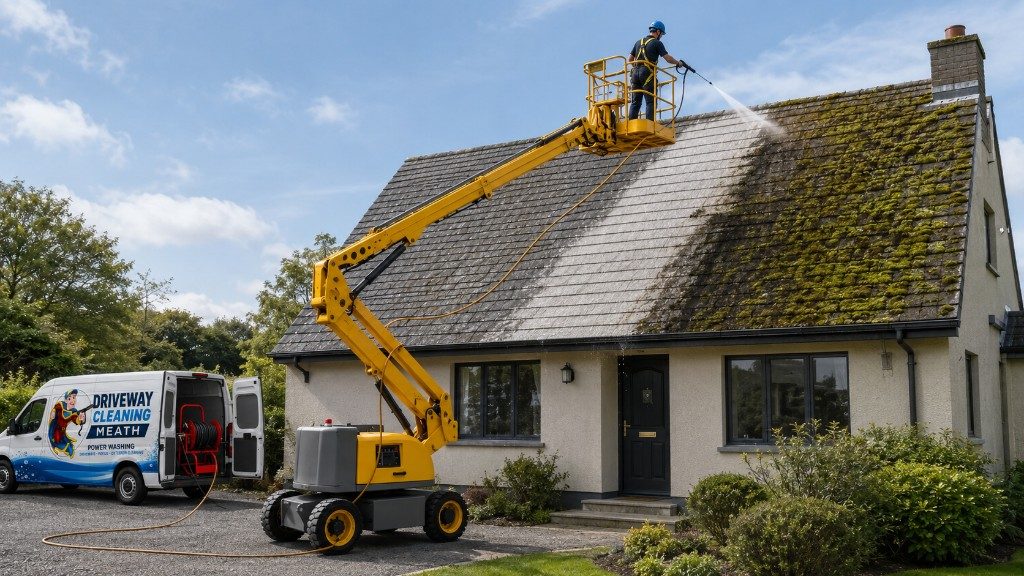
A pressure washer removes what you can see. Softwashing kills the organism with an approved biocide, including the parts buried in the surface that a wash leaves behind. Algae die quickly; moss is anchored by fine roots that work into tiny cracks; lichen is a fungus and an algae living together, with a tough outer skin that protects it — which is why heavy lichen often needs a second treatment a few weeks later.
Because the growth is killed rather than just rinsed off, the next regrowth has to start again from new airborne spores. That's the whole reason a softwash lasts years where a pressure wash lasts months.
Softwash vs pressure wash — the difference
People often ask for a power wash when the surface actually needs a softwash. The two aren't interchangeable, and using the wrong one is how damage happens.
Pressure washing uses force to strip dirt off a surface. It has its place — it's the right first step on a hard, robust driveway. But on a delicate surface it scours the protective layer off render, strips the surface on roof tiles and pits soft stone, and on its own it's a short-term fix: the visible growth comes off but the spores stay embedded.
Softwashing uses almost no pressure — the chemistry does the cleaning, not the force. An approved biocide is applied, left to work, and the growth is killed at the root. It's gentle enough for roofs, render, painted walls and timber, and because it treats the cause the result holds for years.
On many jobs we use both: a low-pressure surface-head wash to take off the heavy dirt, then a softwash so the growth doesn't return. The right method for each surface is something Brendan talks through when he quotes.
Surfaces we softwash
Softwashing is the safe choice across most of the outside of a house:
- Roofs — tile, slate and concrete. Our preferred method for most roofs.
- Render — K-Rend, monocouche, painted render and pebbledash, cleaned without high pressure so the substrate is protected while the green and black staining comes off.
- Painted and rendered walls — including the orange-red staining on north and east-facing render that's commonly mistaken for rust (it's actually an algae).
- PVC fascia, soffits and downpipes — a gentle softwash brings back the original white without hand-scrubbing every metre.
- Decking and timber fencing — cleaned at low pressure so the timber isn't torn up.
- Natural-stone and sandstone patios — always a softwash so the surface isn't pitted or stripped.
If you're not sure which method your surface needs, send Brendan a few photos and he'll tell you which.
Is softwash safe for pets, kids & plants?
Yes — protecting your household and garden is built into how we work, not an afterthought.
We use biodegradable, eco-friendly solutions and protect your landscaping by pre-wetting the plants and beds within range of the spray before the biocide goes on, then rinsing them again afterwards. For pets and children, the rule is simple: keep them indoors during application and until the treated area is dry, usually a few hours. If you have a fish pond, tell us in advance and we'll cover it before we start. The chemistry is approved for the job — not a watered-down domestic bleach mix.
Why we don't recommend pressure washing for most surfaces
A pressure washer is a blunt tool. On the right surface, used carefully, it's useful; on the wrong one it does damage that's expensive to undo — and it never lasts.
- Render — strips the water-repellent layer off K-Rend and silicone renders, and can void the manufacturer's warranty.
- Roof tiles — forces water under the tiles, damages the surface, and leaves the roots and lichen behind to grow back.
- Natural stone and sandstone — pits and scours the surface, leaving it rougher and quicker to re-soil.
- Tarmac — high pressure scours the binder that holds the surface together.
The deeper problem is that pressure washing alone doesn't address why the growth was there — blasting live algae and moss actually spreads the spores, so it comes back faster. A softwash kills the organism, so the only way it returns is from fresh spores landing later. That's why, for roofs, render, walls and most patios, we softwash.
Frequently asked questions
What is softwashing and how does it differ from pressure washing?
Is softwashing safe for my plants and surrounding landscaping?
Is softwash safe for my pets and children?
How long does a softwash last?
Why does the orange or red staining on my render keep coming back?
Talk to us about softwashing
For further details and a no-obligation quote, please call Brendan on +353 87 824 1492 — or send a few photos from your phone.
Free, no-obligation quote — usually back to you within 24 hours. Local to Meath. Owner-operated. Fully insured.